Integrated HCA Human Gut Cell Atlas
As the v1 HCA Human Gut Cell Atlas is released on the HCA Data Portal, the Gut Biological Network team shares how the Atlas was created and why standardized metadata and cell type annotations are so important.
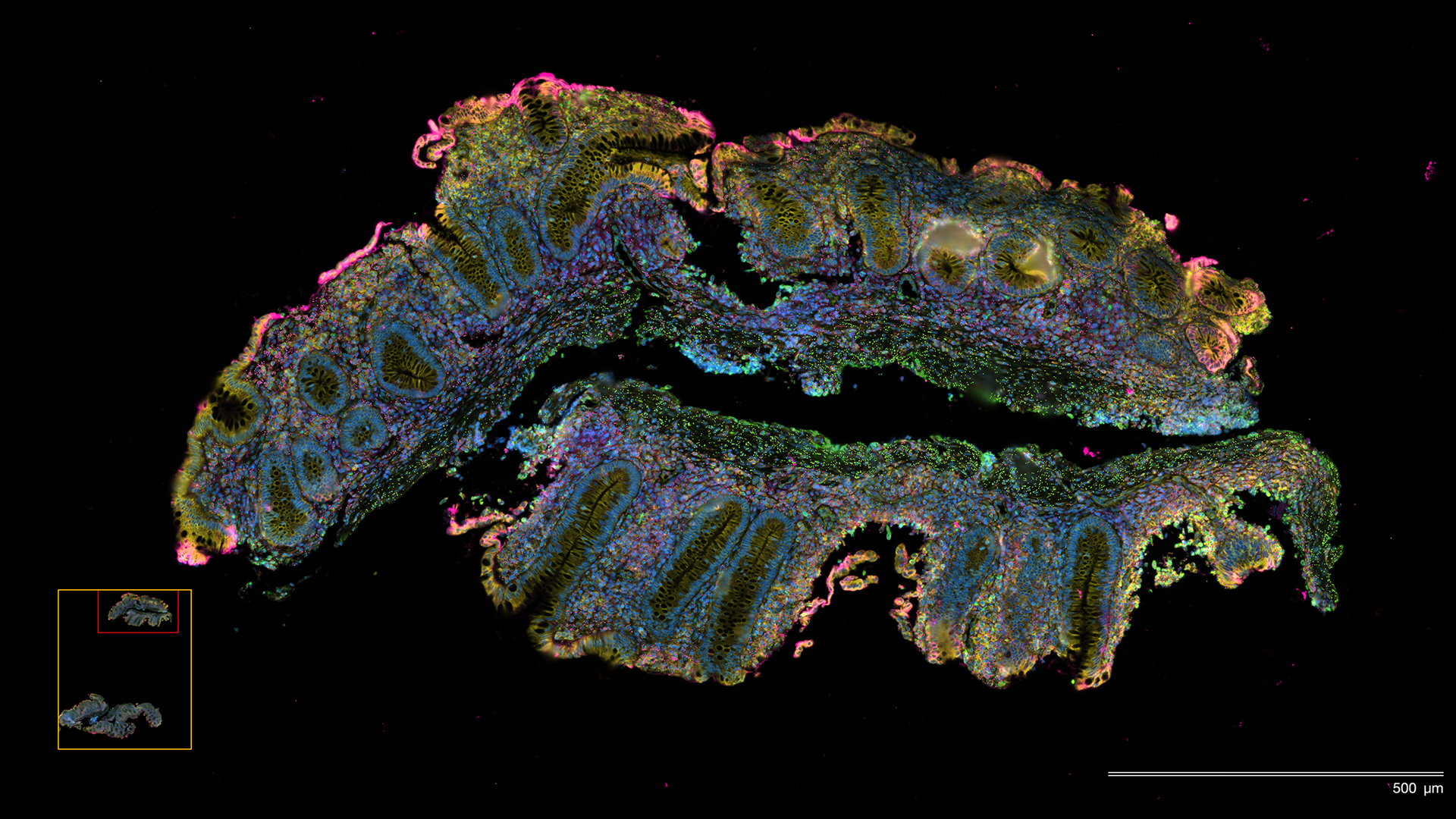
The HCA Gut Biological Network team has created their comprehensive integrated v1 HCA Human Gut Cell Atlas, which is now available on the HCA Data Portal. This single-cell transcriptomic Atlas of the whole human gastrointestinal tract contains nearly a million cells from 24 landmark datasets from 502 samples and 265 donors around the world.
Created from healthy cells, the v1 HCA Human Gut Cell Atlas is a valuable reference for understanding gut health, and will also be used as a resource to help understand what happens in conditions such as Crohn’s and other intestinal diseases.
The human gastrointestinal tract runs from the top of our body to the bottom, and includes the mouth, throat, stomach, intestines and rectum. The v1 HCA Gut Cell Atlas harmonises data across the small and large intestine into a single integrated Atlas that has been extensively annotated by the community.
The high quality and scale of this healthy gut Atlas is allowing the team to map all the subtissues of the gut, find and identify rare cells, and is revealing new insights into cell types across the length of the gut.
Achieving the v1 HCA Human Gut Cell Atlas was a huge challenge, integrating all the data from different organs, patients, sites and laboratories around the world.
José Ordovas-Montanes, an HCA Gut Biological Network Coordinator, said: ‘There were major technical difficulties; from the different sampling methods used to collect tissues and data, to the biological complexity of the length of the gut and the difficulty integrating the different areas. We needed a committed and very organised team of people involved in standardisation, integration and annotation to achieve it.’
‘From Kyle Kimler and Chris Lance - the Biological Network Champions - to all the PhD students and postdoc researchers in the team who have contributed data, this was a big community effort,’ added Matthias Zilbauer, an HCA Gut Biological Network Coordinator.
The HCA Gut Biological Network evolved from an initial consortium focused on Crohn’s Disease, funded by Helmsley Charitable Trust, with HCA researchers involved sharing data from healthy tissues as well. As the Network grew, Biological Network Champions were needed to organise and communicate with the community, first by weekly online meetings, then with a key in-person meeting in Cambridge in June 2024, which led to a leap forward.
Kyle Kimler, a Biological Network Champion and Integration Lead said: ‘It was wonderful to get so many people together at the Cambridge meeting. It was a very multi-disciplinary group, including leaders in gut biology, clinical gastroenterology and computational single-cell analysis, all getting to know each other in-person, to work on the problems together.’
Jose Ordovas-Montanes said: ‘Separate groups at that Cambridge meeting focused on patient-centred metadata, integration and annotation, and how people would use the Atlas. These groups then continued meeting each week online with Kyle and Chris, to solve all the issues involved. HCA Biological Networks are open to anyone, and from that meeting we had a dramatic increase of new team members.’
One of the biggest challenges for the team was collecting the metadata for each dataset. From Tier 1 metadata, such as cell type annotations, information on the sample preparation, or the software used for the initial analysis, to Tier 2 metadata about the patient, the information is vital.
Kyle Kimler said: ‘Metadata is really important. Metadata describes the people that the tissues have come from, and all the experimental conditions used. Without it, we can’t get the integrations to work, or get the biological insights.’
Chris Lance, a Biological Network Champion and Integration Lead, added: ‘We also held community consensus annotation sessions with the Cell Annotation Platform to standardise cell types. These sessions increased the accuracy of annotations on our own atlas data and compared to previous gut atlases. Because of everyone who contributed metadata to this project and helped annotate the cells, the v1 HCA Human Gut Cell Atlas is very well standardised, and will be of great use as a reference to study new data.’
Matthias Zilbauer said: ‘Combining all the data into a single integrated and accessible data set is a huge achievement, and sets us up perfectly for the next phase of the HCA Gut Biological Network. In the future we’d also like to include the intestinal microbiome and how these cells contribute to the variation of human gut cells. Understood together, this will paint a more complete picture of gut function and dysfunction.’
The v1 HCA Gut Cell Atlas was created from mainly single cell RNA sequencing data, including unpublished datasets from Helmsley Crohn’s Gut Atlas groups. While the team is analysing the data, looking for new cell types and specific biological insights from the v1 Atlas, they are also already working towards a v2 Gut Atlas. This will fill in more data from different regions of the world, incorporate additional spatial data, and include interactions with the gut microbiome.
Funding
This work has been supported by Helmsley Charitable Trust, by Biohub through a grant from the Chan Zuckerberg Initiative DAF, an advised fund of the Silicon Valley Community Foundation, and by many other funders who supported the underlying data generation and analysis.